North Korea has reopened a hotline to South Korea, almost two years after it was disabled on the orders of leader Kim Jong-un.
South Korea confirmed it had received a call from the North at 15:30 local time (06:30 GMT) on Wednesday.
The North Korean leader had earlier said he was open to dialogue with Seoul and to sending a team to the Winter Olympics in the South next month.
The two nations have not held high-level talks since December 2015.
North Korea cut off the communications channel shortly afterwards, refusing to answer calls, according to officials in the South.
A North Korean official announced the hotline's reopening in a televised statement.
He said the two nations would discuss the practical issues around a proposal to send a North Korean delegation to the Winter Games in Pyeongchang in February.
"We will make close contact with South Korea in a sincere and faithful manner," Yonhap news agency quoted the official as saying.
The press secretary for South Korea's President Moon Jae-in said the restoration of this communications channel was "very significant".
"It creates an environment where communication will be possible at all times," he said.
Where is the physical line?
According to the South Korean Unification Ministry, there are a total of 33 direct lines that North and South Korea once used to communicate with each other.
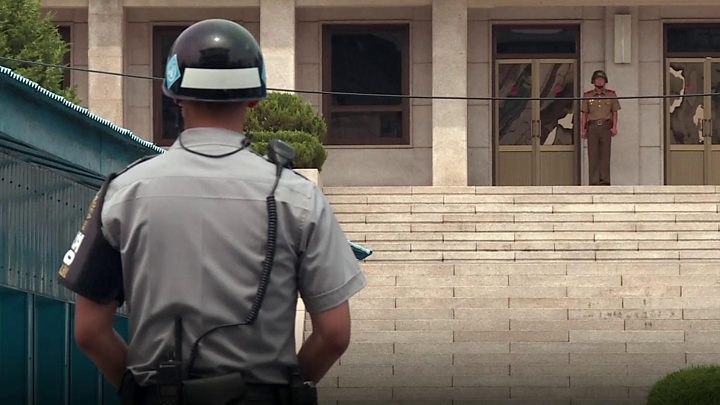
This particular phone line, established in 1971, is based in Panmunjom.
The border village, in the heavily guarded demilitarised zone (DMZ), is where the Koreas have historically held talks.
Image captionKaesong was the last major point of co-operation between the Koreas
The complex was joint economic venture between the two Koreas, but the South suspended the project it in response to a nuclear weapons test by the North.
Will nuclear testing be discussed?
North Korea has come under increasing international pressure in the past year over its nuclear weapons programme.
President Moon said the North's continuing tests would be the backdrop to any new discussions about the Olympics.
The initial call was brief as checks are still being carried out on the line, according to South Korean officials.
What role might the US play?
At the same time as offering an apparent olive branch to the South, Mr Kim used his speech to repeat threats against the US, saying a nuclear launch button was always on his table.
US state department spokesman Heather Nauert said that Mr Kim's latest move "may be trying to drive a wedge of some sort between the two nations - between our nation and the Republic of Korea [South Korea]".




No comments:
Post a Comment